# I Returned From Burying My Husband, and My Family Told Me to Take an Uber—Then They Saw My House on the News
When my mother finally called, I was sitting in a neighbor’s kitchen wearing borrowed slippers.
My hair smelled of smoke. A paramedic had wrapped a blanket around my shoulders, and my untouched tea had gone cold.
“Amelia,” Mom said, breathless. “We just saw your house on television.”
Behind her, I heard my father asking whether I was hurt.
Hours earlier, I had asked them for a ride home from the airport.
Now they wanted to know where I was.
“I’m safe,” I said.
Then I looked across the table at the woman who had opened her door to me before she even knew my name.
## Two Words at the Airport
My name is Amelia. I’m thirty-five, and I had just returned from burying my husband overseas.
James died from a sudden brain aneurysm while we were abroad. In a matter of days, our trip became a blur of hospital corridors, unfamiliar paperwork, and decisions I could barely understand.
By the time my flight reached Portland, I had slept only in fragments.
I turned on my phone while the plane taxied toward the gate and opened our family group chat.
**My flight lands at 5 p.m. Can someone please pick me up?**
Troy answered first.
**We’re busy. Take an Uber.**
Then my mother:
**Why didn’t you plan this better? You know Tuesdays are difficult for everyone.**
I stared at the messages.
I had told them when James died. They knew why I was coming home alone.
Still, I found myself wondering whether I had asked badly. Whether I should have given them more notice. Whether needing someone at the airport was unreasonable.
Finally, I typed:
**No problem.**
My father added a warning about the rain. Mom explained that they had dinner plans with the Hendersons.
I put my phone away.
## The Suitcase That Opened
At baggage claim, I collected two black suitcases containing James’s belongings.
His shirts. His shoes. His shaving kit. The tie he had worn on our anniversary.
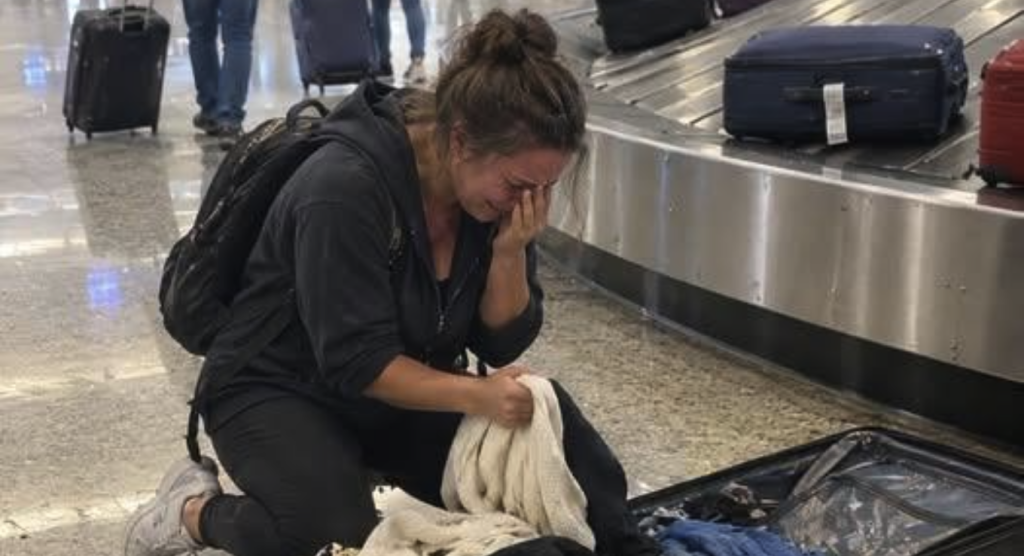
While I pushed the luggage cart toward the exit, a wheel caught. The upper suitcase fell, its damaged zipper splitting open.
His clothes scattered across the floor.
I knelt beside them, trying to gather everything before someone stepped on it.
Then I found one of his shirts beneath the cart.
I held it against my chest and began to cry.
A woman crouched beside me.
“Let’s get these packed,” she said gently.
She helped fold the clothes back inside and secured the broken suitcase with a luggage strap from her own bag.
“Is someone meeting you?”
“No.”
She waited with me until my ride arrived.
I thanked her without asking her name. Later, I wished I had.
## Coming Home Without Him
The house was dark when I arrived.
I left the suitcases by the entrance and stood in the hallway, listening.
James’s jacket still hung on its hook. His running shoes were beneath the bench. An envelope addressed to him lay among the mail.
Nothing in the house seemed to know he was gone.
I sat in his armchair without taking off my coat.
Before our trip, he had arranged several things around the house. The furnace had been serviced, a faulty exterior light replaced, and our aging smoke alarms upgraded to an interconnected system with battery backups.
He had mentioned it while packing.
“One less thing to worry about when we get back.”
I remembered answering from the bedroom, distracted by passports and laundry.
Now I sat beneath one of those alarms and wished I could hear him explain something ordinary again.
Outside, the rain grew heavier.
At some point, I fell asleep.
## The Sound Upstairs
The alarm woke me so violently that I dropped my phone.
A sharp electronic voice repeated a warning, followed by piercing beeps from every level of the house.
For a moment, I couldn’t place the sound.
Then I smelled smoke.
I stood and looked toward the stairs. A gray haze drifted along the upstairs landing.
“James?”
His name left my mouth before I remembered.
The hallway light flickered.
I backed toward the front door, grabbed my phone from the floor, and went outside.
Rain soaked through my socks as I called emergency services.
“There’s smoke in my house,” I said. “I’m outside.”
The dispatcher asked whether anyone else was inside.
“No.”
Saying it hurt.
Across the street, a porch light came on. A woman in a raincoat hurried toward me.
“Come away from the house.”
“My husband’s things—”
“We need to stand back.”
She took my hand and guided me to her driveway.
A window upstairs glowed orange.
Then the glass cracked.
## The Woman Across the Street
Her name was Ruth.
She had lived across from us for eight years. Until that night, most of our conversations had been waves from our driveways.
Now she brought me inside while firefighters arrived.
Her husband, Daniel, stood at the front window, keeping watch. Ruth found dry clothes and placed a towel around my shoulders.
“Who can I call for you?”
I looked down at my phone.
The family chat was still open.
“No one yet.”
She didn’t press.
A paramedic checked me while crews worked across the street. I told him I had been asleep downstairs and had left as soon as I noticed smoke.
Ruth stayed beside me.
When he asked about recent stress or medical concerns, I explained that I had just returned from my husband’s funeral.
Her face changed.
“Oh, Amelia.”
She sat close enough that our shoulders touched.
I cried harder than I had at the airport.
## What James Had Left Behind
The fire was contained before it spread through the entire house, but the upstairs damage was extensive.
There was water downstairs, smoke throughout, and a section of damaged roof above the spare bedroom.
An investigator later told me the initial findings pointed to an electrical fault upstairs. The investigation would take time.
A firefighter asked about the alarms.
“My husband had them replaced before we traveled,” I said.
“They gave you a warning you needed.”
I looked back at the house.
For weeks, I had been trying to understand how someone could disappear so completely.
Yet there was James’s handwriting on a maintenance receipt. There were the appointments he had made, the repairs he had remembered, the ordinary precautions I had scarcely noticed.
One of them had woken me.
I couldn’t thank him. I couldn’t tell him what had happened.
That realization brought another wave of grief, tangled with gratitude.
## The Evening News
A local reporter arrived the next morning to cover the fire.
I spoke briefly after asking that the camera stay out of Ruth’s house.
I explained that the alarms had woken me and that my neighbors had helped.
When the reporter asked about my husband, I told her he had died overseas and that I had returned the previous evening.
She lowered her microphone.
“I’m sorry.”
That evening, the report showed firefighters outside our home, the blackened upstairs windows, and a short clip of me standing beside Ruth.
The caption identified me as a recently widowed homeowner.
My family’s calls began before the segment ended.
Mom called first.
Then Dad.
Then Troy sent:
**Why didn’t you tell us?**
I read it while sitting at Ruth’s kitchen table.
For once, I didn’t rush to make anyone feel better.
## The Conversation We Should Have Had
My parents arrived the following morning.
Dad stood awkwardly on Ruth’s porch. Mom held a grocery bag as though she wasn’t sure where to put it.
She hugged me.
I let her, but I didn’t pretend everything was settled.
“We would have come if we’d known,” she said.
“You knew I was coming home after burying James.”
“I mean the fire.”
“I needed you before the fire.”
She looked down.
Dad pulled out a chair.
“You’re right,” he said quietly. “We should have picked you up.”
Mom began explaining the dinner plans, then stopped.
“We thought you wanted to handle things yourself.”
“I asked you for help.”
There was no way around that sentence.
I hadn’t hidden what I needed. They had decided it could wait.
Mom reached across the table, but I kept my hands around my mug.
“I don’t need an answer today,” I told her. “I need time.”
## Help That Actually Helped
In the days afterward, support became practical.
Ruth helped me list what I needed from the house when access was permitted. Daniel drove me to collect prescriptions and replacement clothes.
A friend accompanied me during the insurance inspection.
My father offered to handle errands. This time, he asked what would help instead of deciding for me.
Troy apologized without adding that he had been busy.
I accepted their assistance cautiously.
Some days, I wanted company. Other days, I didn’t answer the phone.
Grief had already taken so much energy. I stopped spending what remained on convincing people that I deserved care.
Among the belongings recovered downstairs were the two suitcases I had left by the entrance.
James’s clothes smelled faintly of smoke, but most could be cleaned.
I unfolded his anniversary tie and laid it across my lap.
## A Door That Opened
Months later, when repairs were underway, Ruth invited me over for dinner.
Nothing was burning. There were no cameras outside. Nobody needed an explanation.
She simply asked whether I wanted to come.
I brought dessert and helped set the table.
Our family relationships were still uncertain. My parents were making an effort, and I was learning what I could trust.
But I no longer measured my worth by how quickly they answered.
That night at the airport, I had written “No problem” because I didn’t know how to admit how much their refusal hurt.
Now, when someone asked what I needed, I tried to tell the truth.
Sometimes it was a ride.
Sometimes it was someone to sit beside me.
And sometimes it was a place at a table, offered before there was an emergency.