I turned on the microphone.
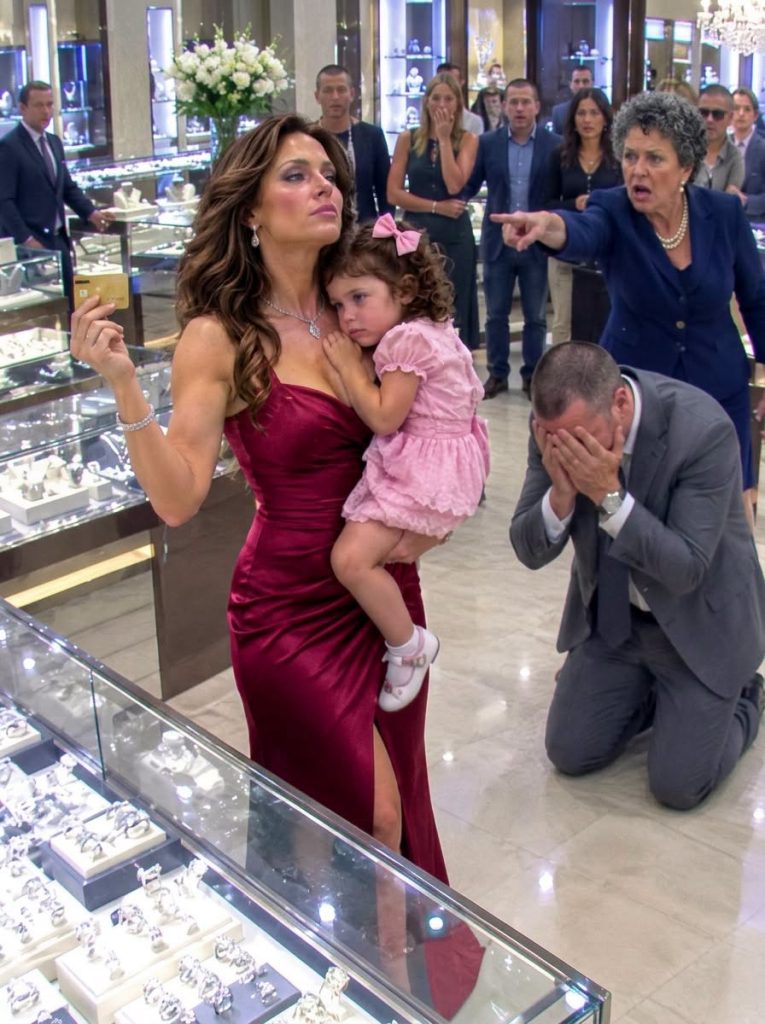
“I’m standing in my bedroom, Harrison. I’m perfectly safe. Stop drilling into my door.”
The locksmith jerked backward. The drill went silent.
Patricia stepped toward the camera.
“Claire, open this door. You have embarrassed this family enough.”
Behind her, Harrison closed his eyes for a fraction of a second.
He recognized the little blue light above the camera.
He had bought that security system himself.
Or rather, he had chosen it. I had paid for it.
“Claire,” he said, carefully now, “we need to talk.”
“You need to leave.”
“My mother has outstanding commitments.”
“Then she should attend to them.”
Patricia’s mouth tightened. “That necklace was for charity.”
“Wonderful. I’m sure the hospital accepts payments from the person who placed the bid.”
The locksmith rose to his feet.
“You told me she wasn’t responding,” he said to Harrison.
“She’s having an episode.”
“No,” I said. “I’m asking you to stop damaging my door. Building security is on its way.”
Harrison looked directly into the camera.
There was the expression I knew. The warning before the slammed cabinet, the broken glass, the long lecture about everything he had sacrificed by marrying someone so difficult.
“You’re making a very expensive mistake.”
I looked at the time on my phone.
6:43.
“No, Harrison,” I said. “You are.”
***
Three years earlier, I had come home from a conference in Chicago and found Patricia sitting at my dining table with six women I had never met.
My wedding china was laid out. A caterer occupied my kitchen. Someone had moved a sculpture from the entryway because Patricia thought it looked “a little commercial.”
She didn’t greet me.
She glanced at my suitcase and said, “Good, you’re back. We’re nearly out of champagne.”
That evening, after everyone left, I asked Harrison how much the party had cost.
He shrugged.
“Does it matter?”
It did, as it turned out.
The caterer cost eleven thousand dollars. The champagne cost four thousand. Patricia had also purchased bracelets for her guests.
Thirty-six thousand dollars.
When I opened the statement, Harrison leaned over my shoulder and kissed the top of my head.
“You work so hard,” he said. “You should enjoy being generous.”
I remember that sentence because it was the last time I confused being useful with being loved.
The next morning, I called my accountant.
I didn’t ask him how to hide my money.
I asked him where it was going.
What he found took six weeks.
Patricia’s credit card was only the visible edge of it.
There were transfers to Voss Heritage Holdings, the company that owned the family’s interest in an aging lakeside resort. Payments to contractors renovating Patricia’s house. A six-figure deposit on a boat Harrison told me belonged to a friend.
And, tucked among ordinary business expenses, invoices issued by a consulting company I had never hired.
Harrison’s consulting company.
My accountant, Martin, sat across from me with a folder between his hands.
“Claire, did you approve these?”
I looked at the signatures.
They resembled mine.
They weren’t mine.
For a while, I couldn’t speak.
Martin waited.
Finally, I asked, “How much?”
“Just over two million so far. We’re still tracing it.”
I had built my logistics software company from a borrowed desk and a laptop with a cracked screen. I remembered rationing groceries to make payroll. I remembered calling my first employee at midnight to promise her the late deposit would arrive in the morning.
And while I was working sixteen-hour days to build something that could survive without me, my husband had been manufacturing invoices to siphon money out of it.
I went home that night.
I cooked dinner.
I listened to Patricia complain that her favorite suite in Paris had become unavailable.
Then I began building my exit.
***
By 6:48, two security officers stood outside my penthouse.
The locksmith immediately handed one of them his work order.
Harrison started talking before anyone asked him a question.
“My wife has a history of—”
“Ex-wife,” I said through the speaker.
The older officer looked up at the camera.
“Ms. Mercer, are you requesting that these people be removed?”
“Yes. Neither has permission to enter. My attorney sent the building a copy of the order yesterday.”
“Understood.”
Patricia drew herself upright.
“Do you know who we are?”
The officer glanced at the ruined lock.
“I know you don’t live here.”
I almost laughed.
Then Harrison lunged toward the camera and covered it with his palm.
“Claire. Listen to me. Whatever you’re doing, call it off.”
That frightened me more than the shouting.
Because now he sounded frightened.
And it was too early.
He wasn’t supposed to know yet.
“What do you mean?” I asked.
“The bank called me.”
I sat down on the edge of my bed.
“What bank?”
“Northstar.”
There it was.
The first domino.
***
Two years into my marriage, Voss Heritage Holdings had been close to losing its resort investment.
Harrison described it as a temporary liquidity problem.
Patricia described it as an opportunity for me to prove I understood family.
I had provided the money.
At first, I provided it the way I provided everything else: quickly, quietly, with the vague expectation that someone who loved me would eventually say thank you.
After Martin found the false invoices, that changed.
My attorney, Elaine Foster, gave me a choice.
We could confront Harrison immediately.
Or we could first secure the money he and his mother kept asking me to advance.
“You cannot make him honest,” she told me. “You can make him sign.”
So every subsequent bailout became a documented loan from my separate investment company.
Proper agreements. Independent valuations. Interest. Maturity dates. Security.
Harrison grumbled about the paperwork.
Patricia said it was vulgar to conduct business within a family.
Neither refused the money.
Their own lawyer reviewed the agreements. Harrison signed the personal guarantees. Patricia signed the pledge covering her ownership interest in Voss Heritage Holdings.
When they needed another eight hundred thousand to finish the resort renovation, they signed again.
When Harrison’s restaurant investment collapsed, he signed again.
When Patricia insisted the family could not possibly sell its lake house, they borrowed against it instead.
Over three years, the loans grew to $6.4 million.
I kept every bank record.
Every request.
Every signature.
And when Harrison demanded a divorce settlement that let him keep the family businesses, I agreed—provided those businesses remained responsible for their debts.
His attorney negotiated the repayment deadline.
Yesterday.
Elaine had pointed to that paragraph during mediation.
“Your client understands that Claire will no longer extend these loans?”
Harrison had smiled at me across the table.
“He understands,” his attorney said.
Harrison believed I would never enforce them.
Even at the end, he mistook my reluctance to hurt people for an inability to protect myself.
***
Outside my door, he lowered his hand from the camera.
“Tell them to stop,” he said.
Patricia stared at him.
“Tell who to stop?”
“The bank.”
“What about the bank?”
He didn’t answer her.
Instead, he looked at the locksmith.
“Could you give us a minute?”
The security officer moved between him and my door.
“You can discuss this downstairs.”
“No.” Harrison’s voice cracked. “This needs to happen now.”
My phone lit up with a message from Elaine.
**Call me. Don’t open the door.**
I called her from my tablet, leaving the security feed open on my phone.
She answered immediately.
“Are you safe?”
“Yes.”
“Good. The building called me. The police are coming.”
“What happened with Northstar?”
“The loans matured without payment. We sent the notices as scheduled. Apparently Harrison called his banker at six thirty.”
“Why?”
“He asked for an emergency transfer from your investment account.”
I stared at the hallway feed.
Harrison was still talking, one hand raking through his perfect hair.
“He no longer has authority on that account.”
“No,” Elaine said. “He doesn’t.”
There was a pause.
“Claire, he sent them an authorization letter.”
My mouth went dry.
“With my signature?”
“Yes.”
For five years, I had wondered what Harrison would do if I finally said no.
Now I knew.
He would try to turn my no into my signature.
“The banker called your controller to verify it,” Elaine continued. “She flagged it immediately. We have the original email and the attachment.”
Outside, Harrison glanced at his watch.
Then at his mother.
Then back at my door.
He hadn’t come upstairs to talk.
He had come to reach my laptop.
My phone.
The little device in my desk drawer that generated the second authorization code for large transfers.
I thought of the drill chewing into the lock.
The story about me hurting myself.
His insistence that everything had to happen immediately.
For a moment, the room seemed to tilt.
“Elaine,” I said, “he’s trying to get access to the account.”
“I know. Your controller has disabled the remaining devices. Nobody can move that money.”
I pressed my bare feet against the floor until the cold marble steadied me.
“Send the police the letter.”
“Already preparing it.”
***
At 7:02, the elevator opened.
Two police officers stepped into the hallway.
Harrison immediately straightened his jacket.
Thank God, he seemed to be thinking. An audience he could persuade.
“My ex-wife is distressed,” he began.
The older security officer handed over the locksmith’s work order.
The younger police officer looked at the damaged door, then up at the camera.
“Ma’am, can we speak with you?”
“Yes,” I said. “I’ll come out when they’ve moved away from the entrance.”
Harrison turned toward Patricia.
For the first time that morning, neither of them spoke.
I dressed before opening the door.
Nothing dramatic. Jeans. A sweater. Shoes.
I wanted shoes.
That small detail remains sharper in my memory than almost anything else. I was tired of confronting crises barefoot in my own home.
When I stepped into the hallway, Patricia’s eyes dropped to my left hand.
My wedding ring was gone.
“You’ve made your point,” she said. “Now fix this.”
I looked at the metal shavings scattered across the marble.
The locksmith stood near the elevator, pale and miserable.
“You were told this was an emergency?” I asked him.
He nodded.
“He said you’d threatened to hurt yourself. He showed me an old building access card.”
“I understand.”
Harrison tried to step forward.
An officer stopped him.
“Claire,” he said, “please.”
There was that word.
I had heard it when he needed money, when he needed an alibi, when he needed me to apologize to his mother.
I had almost never heard it attached to something he intended to do for me.
“The bank won’t release the funds,” he said. “If you just authorize the payment, we can sort everything else out later.”
“No.”
“They’ll take the lake house.”
“That was your collateral.”
Patricia made a small, wounded sound.
“My husband bought that house.”
“And you pledged it for a loan.”
“You said you were helping us.”
“I was.”
Harrison’s eyes filled with tears.
Whether they were real, I still don’t know.
“Six million dollars, Claire. You’re going to destroy us over money you don’t even need?”
Behind him, the elevator doors reflected all of us: the officers, his mother, the damaged door, me.
For years, I had imagined this moment would feel triumphant.
Instead, I felt terribly tired.
“You could have sold the boat,” I said. “You could have sold the resort stake. You could have stopped spending. You had months to arrange repayment.”
He shook his head.
As if my account of events was a disappointing story he wanted me to revise.
“You knew we couldn’t pay.”
“I knew you didn’t intend to.”
***
The officers separated us.
I gave my statement inside the penthouse with Elaine on speaker. Building security supplied the footage. The locksmith supplied his messages with Harrison.
When an officer asked whether I had authorized anyone to sign the bank letter, I answered clearly.
“No.”
Harrison left the building with the police.
Patricia stayed behind long enough to make one final attempt.
She stood beside the elevator with her expensive coat draped over one arm.
“If you do this,” she said, “you will never be welcome in this family again.”
Five years earlier, that would have frightened me.
Five months earlier, it might have hurt.
That morning, I looked at my ruined front door and understood that she was offering me exactly what I had spent years trying to obtain.
“I know,” I said.
***
It took months.
That is the part people leave out when they tell stories about getting even.
Banks do not recover millions because a woman delivers a perfect sentence in a hallway. Lawyers send letters. Accountants reconcile transfers. People who owe money suddenly develop elaborate objections to documents they signed without complaint.
Patricia’s lake house was sold.
The boat went first.
The family’s resort interest followed, after a negotiated sale that recovered most of the outstanding balance. Harrison had to liquidate investments he had kept during the divorce. The remaining debt became part of a settlement secured against what he still owned.
The false invoices and forged authorization went through a separate investigation.
I gave them the records.
I answered their questions.
Then I let my attorney handle the calls.
By spring, Martin placed the final recovery statement on my desk.
I looked at the number.
Then I looked at the last page.
No pending transfers.
No family advances.
No authorized users.
I signed it and went back to work.
***
My new front door arrived six weeks after the old one was damaged.
While the installer adjusted the hinges, he asked whether I wanted extra copies of the keys.
I thought about the drawer in my kitchen where Patricia used to keep a spare. About Harrison letting himself into my office to borrow a charger, read a statement, take something he assumed belonged to him.
“Two,” I said. “One for me. One for someone I choose.”
That evening, I walked to a little restaurant three blocks from my building.
I ordered dinner.
Halfway through, my phone buzzed with an alert.
For a second, my body reacted before I could read it.
Then the screen lit up.
A payment notification.
My meal. My card. My money.
I left a generous tip, put the phone away, and stayed for dessert.