# Every Grandchild Got a Gift at My Parents’ Christmas Party, Except Mine—Then My Mother Told Us We Weren’t Welcome
My daughter Emma was six years old when she learned that adults could be cruel while smiling.
It happened at my parents’ Christmas party, beneath a tree crowded with presents. Every grandchild had a gift waiting.
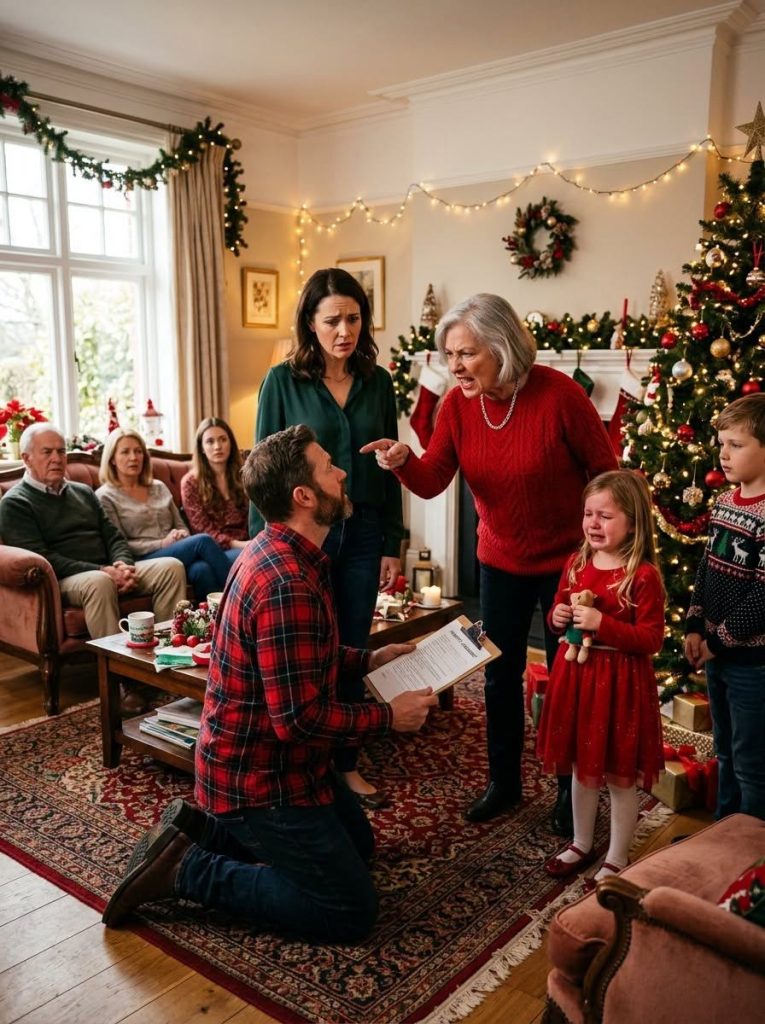
Every grandchild except mine.
My mother thought humiliating my children would make me give in to her demands. What she hadn’t considered was that the next payment for her home renovations was still sitting in my bank account.
## The Presents Under the Tree
Karen and I arrived carrying a casserole and the cautious hope that Christmas might soften things between us and my parents.
Emma had talked about the party all morning. Grandma had mentioned a unicorn set weeks earlier, and Emma remembered every detail.
Her younger brother, Ryan, was simply excited to see his cousins.
The moment we entered, both children headed toward the tree.
There were presents for my sister Amanda’s three children, packages for our cousins, and even a gift for a neighbor’s baby who wasn’t attending.
Emma crouched down and read the tags she could reach. She moved carefully around the tree, checking each name.
Then she looked up.
“Daddy, are ours hidden?”
Amanda lowered her wineglass. My father kept his eyes on the television.
My mother stood beside the fireplace, watching.
“There aren’t any gifts for them,” she said.
Karen’s hand found mine.
“Why?” I asked.
Mom straightened the pearls around her neck.
“Because this family doesn’t reward disrespect.”
Emma stood slowly. Her excitement gave way to confusion.
“They’re children,” Karen said.
“They’re your children,” my mother replied. “After the way you two have treated us, we don’t welcome them here.”
Ryan pressed against my leg.
No one spoke up.
## What My Parents Called Loyalty
Two months earlier, my parents had asked me to buy them a house in a gated neighborhood.
They presented it as something I owed them.
They had raised me. They had made sacrifices. Now that I was earning a comfortable living, they believed I should provide the retirement they wanted.
Karen and I discussed it privately. Between our mortgage, savings, and two young children, purchasing another house was impossible without sacrificing our own financial stability.
When I refused, Mom cried.
Dad called me ungrateful.
Amanda said I was abandoning our parents.
Then my father mentioned problems in their current house: unreliable wiring, leaking pipes, damaged walls, and worn flooring.
I offered to pay for necessary repairs.
Since October, I had spent $21,480.
I thought helping them make their home safe would show that I cared, even if I couldn’t give them everything they wanted.
Standing beside the Christmas tree, I understood how little that effort meant to them.
Dad finally turned away from the television.
“Maybe now you’ll understand that choices have consequences.”
“You’re punishing my children because I wouldn’t buy you another house?”
“Don’t twist this,” he said. “You embarrassed your mother.”
Mom folded her arms.
“Amanda understands family loyalty. You only care about your wife and those children.”
Those children.
Emma’s eyes filled, but she pressed her lips together, determined not to cry.
## Leaving Before Dinner
I knelt beside my daughter and zipped her coat.
“Did we do something bad?” she whispered.
“No, sweetheart. You did nothing wrong.”
I helped Ryan into his jacket, then lifted him into my arms.
Karen still held the casserole. She placed it on the table without speaking.
“You’re leaving before dinner?” Amanda asked.
“Yes.”
Dad gave a short laugh.
“Stop being dramatic. The contractor is coming Tuesday to finish the bathroom. Make sure the payment clears.”
I looked at him for a moment.
Then I turned to my mother.
“You said my children aren’t welcome here.”
“That’s right.”
“Understood.”
We left.
Emma began crying before we reached the end of the driveway. Karen climbed into the back seat and held both children while I sat behind the wheel.
My phone vibrated.
It was a reminder from the contractor.
**Final phase payment scheduled: $8,120. Confirmation required.**
I opened the account and withdrew authorization for future charges.
Then I wrote to the contractor:
“Please pause any work beyond what I have already approved. I will settle outstanding charges for authorized work, but I will not fund additional work or upgrades.”
Before driving away, I turned toward the back seat.
“We’re going home,” I told the children. “And we’re still going to have Christmas.”
## The Christmas We Chose
We ordered pizza.
Karen and I brought out the presents we had bought, and afterward we built a blanket fort across the living room.
Ryan insisted that every stuffed animal needed a place inside.
Emma appointed herself the person in charge of the fairy lights.
By bedtime, she was smiling again.
But while I tucked her in, she asked, “Does Grandma not love us anymore?”
I sat beside her.
“I don’t know why Grandma chose to say something so hurtful,” I answered. “But you are loved. You never have to earn that by getting someone a house or making them happy.”
“Are we going back?”
“Not unless we know you’ll be treated kindly.”
She nodded and held my hand until she fell asleep.
For three days, my parents said nothing.
On the fourth, Amanda called nine times.
On the fifth, Mom left a voicemail about the unfinished bathroom. She never mentioned Emma or Ryan.
On the seventh morning, Dad called.
“You have one hour to fix this,” he said. “You started these repairs. You’re responsible for finishing them.”
“Send me the invoices.”
“You can come here and explain yourself.”
“I’ll be there at six.”
## The Folder on the Table
My parents had assembled an audience.
Amanda, Uncle Rob, and two other relatives sat in the living room when I arrived.
Dad dropped a stack of invoices onto the coffee table.
“Pay them.”
I placed a folder beside his.
It contained receipts, emails, and the original agreement listing the repairs I had approved.
My mother smirked.
“A folder won’t save you.”
Before I could answer, the doorbell rang.
Mark, the contractor, stepped inside carrying several documents. After receiving my message, he had asked to review the account with everyone present.
He laid three change orders on the table.
“We need to clarify these before discussing another payment.”
Dad waved toward me.
“Steve is paying.”
Mark shook his head.
“Steve approved the original repair scope. These are additional upgrades.”
He pointed to the first page.
“A larger vanity. Premium tile. A different flooring package. Together, they add almost six thousand dollars.”
I looked at the signatures.
My name appeared on all three.
I hadn’t signed any of them.
## The Upgrades I Never Approved
“Who authorized these?” I asked.
Mom looked toward Dad.
Amanda studied her hands.
Mark opened an email on his tablet.
“Your mother sent the approvals. She said you had reviewed them and asked her to handle the paperwork.”
“I didn’t.”
Mom leaned forward.
“They were sensible improvements. You were already paying for the room.”
“That didn’t give you permission to sign my name.”
Dad interrupted.
“Don’t make this ugly.”
I looked down at the papers again.
The changes were dated after I had told my parents there would be no additions to the agreed budget.
They had heard my answer and found a way around it.
Mark gathered the documents.
“I’ll send an itemized statement separating completed, approved work from these changes. The remaining project needs a new agreement with the homeowners.”
Uncle Rob finally spoke.
“You told us Steve had promised to pay for everything.”
“He should have,” Mom said.
“That isn’t what I asked.”
For the first time that evening, she had no answer.
## What I Was Willing to Pay
I paid the outstanding balance for work I had actually approved after reviewing Mark’s statement.
My parents arranged their own financing for the rest.
I also sent them a written notice that I would provide no further renovation money and that no one had permission to sign documents on my behalf.
Amanda called the next evening.
“Mom is devastated.”
“Has she asked how Emma is?”
A pause.
“She thinks you’ve blown this out of proportion.”
“Emma asked whether she had done something bad. Ryan was afraid to let go of me.”
“They’re little. They’ll forget.”
“I won’t.”
Amanda sighed.
“What do you want Mom to do?”
“Apologize to the children without blaming anyone else. And stop treating my family as something she can use to pressure me.”
“She’s your mother.”
“I’m their father.”
There was nothing more to say.
## A Different Kind of Family Gathering
Several weeks later, an envelope arrived from my parents.
Inside was a gift card.
There was no note for Emma or Ryan.
I put it aside. I wasn’t going to present it to the children as an apology that had never been offered.
That spring, we hosted dinner for friends and their families. The children scattered toys across the living room while the adults squeezed around our table.
Emma showed one of our friends a drawing she had made.
“That’s our house,” she explained. “Everybody can come.”
I watched her return to the other children, laughing.
Later, while Karen and I washed dishes, she asked whether I missed my parents.
“Sometimes,” I said.
She rested her shoulder against mine.
I missed ordinary conversations. I missed believing that showing up and helping would eventually bring us closer.
But I no longer confused that hope with a reason to expose my children to another humiliating afternoon.
My parents could decide who entered their home.
Karen and I could decide what our children learned in ours.
They would learn that kindness mattered, that apologies required words and changed behavior, and that someone would stand beside them when they were hurt.
That Christmas, Emma and Ryan left my parents’ house without presents.
They went home with parents who chose them.
And we would keep choosing them.