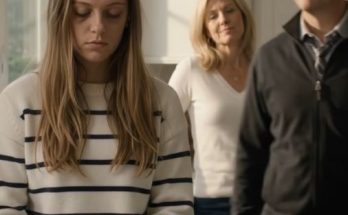
Claire Whitmore had spent six years measuring her worth in numbers that refused to rise. Hormone levels. Follicle counts. Embryo grades. Negative pregnancy tests that arrived with the same quiet finality as a door closing. She and Daniel had married at twenty-seven with the easy certainty of people who believed love could solve anything. Their apartment filled with baby-name lists and paint swatches for a nursery that never quite materialized. Then the trying began, and the trying never ended.
Hormone injections left purple blooms across her hips and thighs. She learned to inject herself in the bathroom while Daniel was still asleep so he would not have to watch. Surgeries followed—laparoscopies, hysteroscopies, the scraping and examining of a body that refused to cooperate. IVF came next, clinical and expensive. Claire sat in waiting rooms filled with other women who avoided eye contact, all of them clutching the same fragile hope. She smiled when doctors delivered bad news in soft, careful voices. She cried only after Daniel’s breathing deepened into sleep, her face pressed into the pillow so the sound would not travel.
Daniel held her through the early failures. He brought her tea and stroked her hair and said the right things. But as the years stacked up, the holding grew thinner. Conversations shortened. His eyes began to drift during dinner. One night he placed a thin stack of divorce papers on the nightstand beside her evening medication, as casually as if he were leaving a note about the dry cleaning.
“I want children, Claire.”
“So do I.”
He would not look at her. His gaze stayed fixed on the wall above her head. “I can’t keep waiting for something your body may never give me.”
The words landed like a physical blow. Claire stared at the papers, at the neat black lines of legal language that would erase six years of shared life. She asked the question she already knew the answer to.
“Is there someone else?”
There was. Her name was Madison. She worked in the marketing department of Daniel’s firm. Young, bright, and, as it turned out, already pregnant.
“With Madison, it happened naturally,” Daniel said later, when the papers were signed and the movers had taken the last of his boxes. Those five words hurt more than the divorce itself. Naturally. As if Claire’s body had been a deliberate failure rather than a medical reality neither of them had chosen.
Six weeks after the papers were finalized, the marriage was legally over. Within months, Madison became Mrs. Whitmore. Claire moved into a smaller apartment across the city, one with thinner walls and a kitchen that never quite got warm. She boxed up the baby clothes she had bought in hopeful moments and stored them in a closet she rarely opened. She told herself she was starting over. She almost believed it.
What Daniel had forgotten—what he had deliberately chosen not to remember—were the three frozen embryos.
During their final IVF cycle, the clinic had created several viable embryos using Claire’s eggs and Daniel’s sperm. Three had been graded highly and cryopreserved. In the hurried, bitter process of the divorce, the clinic required both parties to sign an agreement regarding the disposition of any remaining genetic material. Daniel signed the form granting Claire sole control over their future use. He signed without reading most of it, sliding the papers across the conference table with a dismissive flick of his wrist.
“I don’t want anything connected to this nightmare,” he said. “Keep them, destroy them, I don’t care. Just don’t involve me.”
Claire never forgot those words. She carried them with her like a small, sharp stone in her pocket.
Eight months after the divorce was final, she returned to the clinic alone. The doctor reviewed her records, noted the previous failures, and still agreed to transfer all three embryos. The odds were low. Claire signed the consent forms with a steady hand. She did not tell Daniel. She did not owe him notification. The authorization was hers.
All three embryos implanted. All three survived the critical first weeks. Against every prediction that had haunted her for six years, the pregnancies held. Claire’s body, the same body that had been declared inadequate, carried three living children to term. The delivery was early, chaotic, and terrifying. When the first cry rang out, then the second, then the third, Claire sobbed so hard the nurses had to support her shoulders. Noah. Eli. Grace. She named them in the recovery room while the monitors still beeped and the fluorescent lights hummed. She did not call Daniel. He had made his choice. She would make hers.
The first year of single motherhood with triplets was a blur of staggered feeds, laundry that never ended, and the constant, low-grade fear that she would drop one of them. Claire learned to nurse two at once while the third waited in a bouncer. She learned the difference between hungry cries and tired cries and the particular wail that meant an ear infection was coming. She sold the last of her wedding jewelry to buy a second-hand triple stroller. She stopped answering questions from acquaintances about the father. When people stared at the three identical crescent-shaped birthmarks behind the babies’ left ears, she simply smiled and changed the subject.
The birthmarks were the same shape as the one Daniel had carried since childhood—a small, pale crescent just behind the ear. Claire noticed them the day the babies came home from the hospital. She said nothing. Some truths did not need to be spoken aloud.
Almost a year after the birth, Grace developed a fever that would not break. Claire’s usual babysitter was out of town. With no other option, she bundled all three children into the car and drove to the pediatric clinic that handled their well-child visits. The waiting room was bright and noisy, decorated with cartoon animals and the partial words “PEDIATRIC CARE” painted across one wall. Claire settled onto a teal couch, arranged Noah and Eli beside her in their blankets, and covered herself with a nursing shawl when Grace began to root. The two boys slept. Grace latched and fed with quiet determination.
Claire was adjusting the shawl when someone said her name.
“Claire?”
The voice stopped her cold. She looked up.
Daniel stood in the doorway of the pediatric wing. He wore a navy suit, the same cut he had favored during their marriage. Madison stood beside him, one hand on the handle of a sleek black stroller. Inside the stroller, a baby slept under a white blanket. Daniel’s eyes dropped first to Grace at Claire’s breast, then to the two infants sleeping against her side. His face went white.
Noah turned his head in sleep. The crescent birthmark was clearly visible. Daniel’s hand rose almost without thought and touched the identical mark behind his own ear. Eli shifted. Same mark. Grace had it too, partially hidden by the edge of the shawl.
“How old are they?” Daniel whispered.
Claire did not answer. She kept her eyes on his face and waited.
His gaze moved as he calculated months, counting backward from the present. Realization settled over him like a weight. “The embryos.”
Madison’s fingers tightened on his arm. “Daniel, we should go.”
He ignored her. His voice roughened. “You used them?”
“You signed the authorization,” Claire said. Her tone was even. She had rehearsed this conversation in her mind a hundred times and never expected to have it. “You said you didn’t want anything connected to the nightmare. I took you at your word.”
He stared at the three children—the three living children he had spent years claiming she could never give him. “Are they mine?”
Claire adjusted Grace in her arms. “They were created from my eggs and your sperm. Biologically, yes. Legally, they are mine alone. You signed away any claim.”
Daniel stumbled backward and dropped into a chair against the wall. His hands hung between his knees. Three children. The family he had abandoned her for failing to produce. Madison stood frozen beside the stroller, her face tight with something that looked less like shock and more like dread.
A nurse appeared at the doorway holding a manila folder. “Mr. and Mrs. Whitmore?”
Madison stiffened. The nurse continued in a professional, slightly hurried tone. “We received the results your pediatrician requested. They’re ready for review whenever you’re prepared.”
Daniel looked up, confused. “What results?”
Madison’s face drained of color. She stepped closer to him, voice low and urgent. “Daniel. Please. Let’s leave. We can come back another day.”
But Claire had spent six years analyzing numbers, dates, and the fine print of medical records. She watched Madison’s knuckles whiten on the stroller handle. She looked at the baby sleeping under the white blanket—the child Daniel had left her for, the child conceived “naturally.” Then she looked at Daniel, still pale and reeling from the sight of his triplets. Then she looked at the folder in the nurse’s hands.
Something cold and precise settled in Claire’s chest. Daniel had just discovered that the supposedly infertile wife he discarded had carried and delivered three of his children. Judging by the terror on Madison’s face, he was only seconds away from learning something far more damaging about the child he had chosen instead.
The nurse stepped closer, folder open. Madison’s voice cracked. “Daniel—”
He turned toward the file. Claire sat very still on the teal couch, Grace still nursing, Noah and Eli breathing softly beside her. She did not speak. She did not need to. The truth she had never chased was arriving on its own, carried in a manila folder under fluorescent lights, in a waiting room decorated with cartoon elephants and the partial promise of pediatric care.
Daniel’s hand reached for the results. Madison’s plea dissolved into silence. And Claire, who had learned long ago how to smile through bad news and cry only when no one was watching, simply held her daughter and waited for the next truth to land.