For eight years, Ricardo said he was praying for a son.
We already had four daughters—Sofía, Valentina, Camila, and Renata—and I loved the noisy, beautiful family we had built. Ricardo loved the girls too. He packed their lunches, attended their school plays, and taught them to kick a soccer ball in the yard.
But after each birth, I saw the same thing: a flash of disappointment before he smiled.
“Maybe next time,” he would say.
By the time Renata was born, I had begun to hate those words. They made our daughters sound like four attempts that had gone wrong.
I told Ricardo I could not keep having children just so he could pass down the family name to a boy. My body was tired, and our house was already full. But his late father had spent years talking about an heir, and Ricardo carried that expectation as if it were a debt.
Eventually, after many difficult conversations, I agreed to try once more.
When the ultrasound technician told us the baby was a boy, Ricardo cried. He painted the nursery navy blue, ordered a wooden sign bearing the name Mateo, and bought tiny soccer shoes months before our child could even stand.
“My son,” he would whisper with his hand on my stomach.
I noticed that he rarely said our son, but I convinced myself it was only excitement.
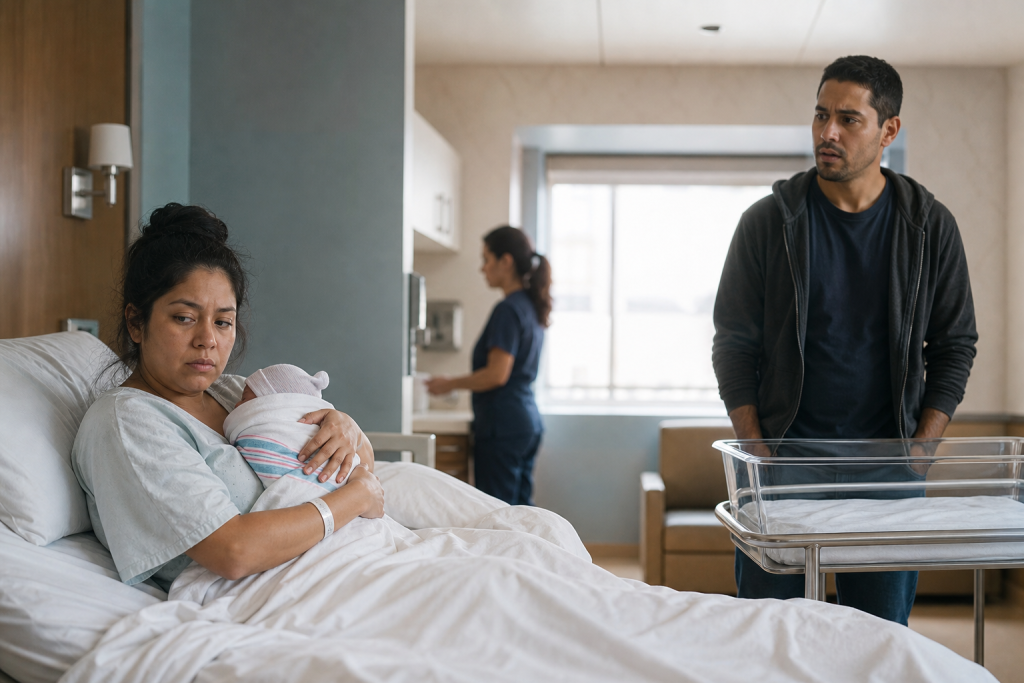
Mateo arrived after nearly twelve hours of labor. When the nurse placed him on my chest, the exhaustion fell away for one perfect moment. He was warm, furious, and astonishingly small.
Ricardo stood beside me with tears on his face.
“You did it,” he said.
“We did it,” I corrected him.
He kissed my forehead, photographed Mateo, and called everyone he knew. The son he had dreamed about for eight years was finally here.
Then a nurse unwrapped Mateo for an examination.
Near the base of his back was a pale, crescent-shaped birthmark.
Ricardo stopped speaking.
“What is it?” I asked.
The nurse glanced at the mark. “Just a small area of lighter pigmentation. The pediatrician will look at it, but it doesn’t appear concerning.”
Ricardo stepped closer to the bassinet. His face had drained of color.
“Javier has that mark.”
I stared at him. Javier had been his closest friend since high school. He had helped with school pickups and groceries when Ricardo worked late, and he treated our daughters like nieces.
Months earlier, Ricardo had made one strange comment after a neighbor joked that Javier knew our family schedule better than he did.
“People could get the wrong idea,” Ricardo had said.
I thought he was embarrassed about working so much. I never imagined he had turned the joke into a suspicion.
“You know about Javier’s birthmark because you changed in the same locker room for years,” I said carefully. “That does not mean anything.”
Ricardo looked from Mateo to me.
“That baby is not mine.”
The words struck harder than any shout could have.
I had carried his child, endured labor, and given him the son he claimed to want. Hours later, he had reduced our entire marriage to a mark on a newborn’s skin.
“Then get a DNA test,” I said.
“I know what I saw.”
“You saw a birthmark. You did not see a betrayal.”
He grabbed his jacket.
“When you’re discharged, stay with Elena. I can’t bring that child into my house.”
That child. Not Mateo. Not our son.
He walked out while I held our baby against my chest and tried not to fall apart.
Three days later, I was at my sister Elena’s home with Mateo and the girls. Ricardo had sent two short messages asking about the DNA test. He had not asked how I was healing or whether his children needed him.
That afternoon, Javier arrived carrying a worn folder.
“Ricardo called me,” he said. “He asked about the mark.”
“Then you know what he thinks.”
Javier’s face tightened. “He is wrong. But his call made me open something my father left me.”
Javier’s father, Arturo, had been adopted as an infant. Near the end of his life, he petitioned to have his original records unsealed. The process took years, and the final documents arrived shortly before he died. Grief had kept Javier from examining them closely.
Inside the folder was a copy of Arturo’s original birth certificate. The line identifying his father contained a name I recognized immediately: Emilio Morales.
Ricardo’s grandfather.
“That can’t be right,” I whispered.
“I thought it was another man with the same name,” Javier said. “Then I found this.”
He handed me a letter written by Emilio to Arturo’s mother. In it, Emilio promised to provide money while insisting that the child could never be acknowledged. His marriage and reputation, he wrote, depended on silence.
Arturo had been Emilio’s son. Ricardo’s late father, Andrés, had also been Emilio’s son.
That made Arturo and Andrés half brothers—and Ricardo and Javier half-first cousins.
The birthmark did not prove Mateo belonged to Javier. It revealed that Javier and Ricardo shared a hidden branch of the same family.
But it still did not prove paternity. For that, we needed the DNA test.
The following morning, Ricardo’s mother, Teresa, came to Elena’s house. She carried a small metal box that had belonged to Andrés.
“My husband knew,” she said before she even sat down. “He discovered Arturo’s existence after Emilio died, but he was ashamed. He made me promise not to tell Ricardo.”
The box contained letters, photographs, and an old military medical record. Among Emilio’s identifying features, a doctor had noted a pale crescent-shaped patch near his lower back.
Neither Andrés nor Ricardo had the mark. Javier did. Now Mateo did too. Whatever its precise medical explanation, the mark could have traveled through either side of a family the two men never knew they shared.
Teresa began to cry.
“Andrés believed hiding the truth protected the family name,” she said.
I looked down at Mateo. “That name has protected everyone except the children.”
Ricardo came to Elena’s house that evening. Teresa had already told him everything.
He stood in the doorway staring at the baby in my arms.
“I was wrong,” he said.
“You were more than wrong. You accused me of cheating. You abandoned me after I gave birth. You rejected your son before you knew anything about him.”
Ricardo lowered his eyes. “I know.”
“You wanted a son more than you wanted to trust me.”
He had no answer.
When he reached toward Mateo, I stepped back.
“Can I hold him?” he asked.
“Not yet.”
For once, Ricardo did not argue. He left after arranging to give his DNA sample the next morning.
The results arrived several days later. The probability of paternity was greater than 99.9 percent. Ricardo was Mateo’s biological father.
He read the report twice, then covered his face and cried.
But the result did not repair what he had broken. Biology answered one question; it did not restore trust.
I remained at Elena’s house. Ricardo began therapy and joined a parenting group. He paid the household expenses, handled school runs, brought meals, and cared for the girls without treating those tasks as favors to me.
Most importantly, he apologized to our daughters.
“Every time I said I needed a son, I made you feel like you were not enough,” he told them. “That was my failure, not yours.”
Sofía did not hug him. Valentina asked why it had taken him so long to understand. Camila cried. Renata climbed into his lap.
He accepted every response without defending himself.
My forgiveness came slowly. Some days I believed our marriage could survive; other days, I remembered the hospital door closing behind him and felt the wound open again. Ricardo learned that remorse was not the same as repair. An apology happened once. Accountability had to happen every day.
Nearly a year after Mateo’s birth, I watched Ricardo playing soccer in Elena’s yard—not only with the boy he had longed for, but with all five of our children.
Mateo tottered after the ball, fell into the grass, and began to laugh. Ricardo picked him up. When Mateo’s shirt shifted, the crescent-shaped mark appeared above his waistband.
Ricardo saw it. His expression tightened for a moment, and then he kissed the top of Mateo’s head.
Later, he told me what he had whispered.
“I told him he will never have to earn his place in this family.”
The mark had uncovered a secret that generations of men had hidden to protect their idea of a family name. It did not excuse Ricardo’s accusation, and it did not magically heal our marriage.
But it forced him to confront a truth his father and grandfather never had: a family is not preserved by silence, pride, or blood alone. It is preserved by honesty, trust, and the courage to stay when love requires difficult work.
The crescent on Mateo’s back never proved that he wasn’t Ricardo’s son.
In the end, it helped reveal that he was.