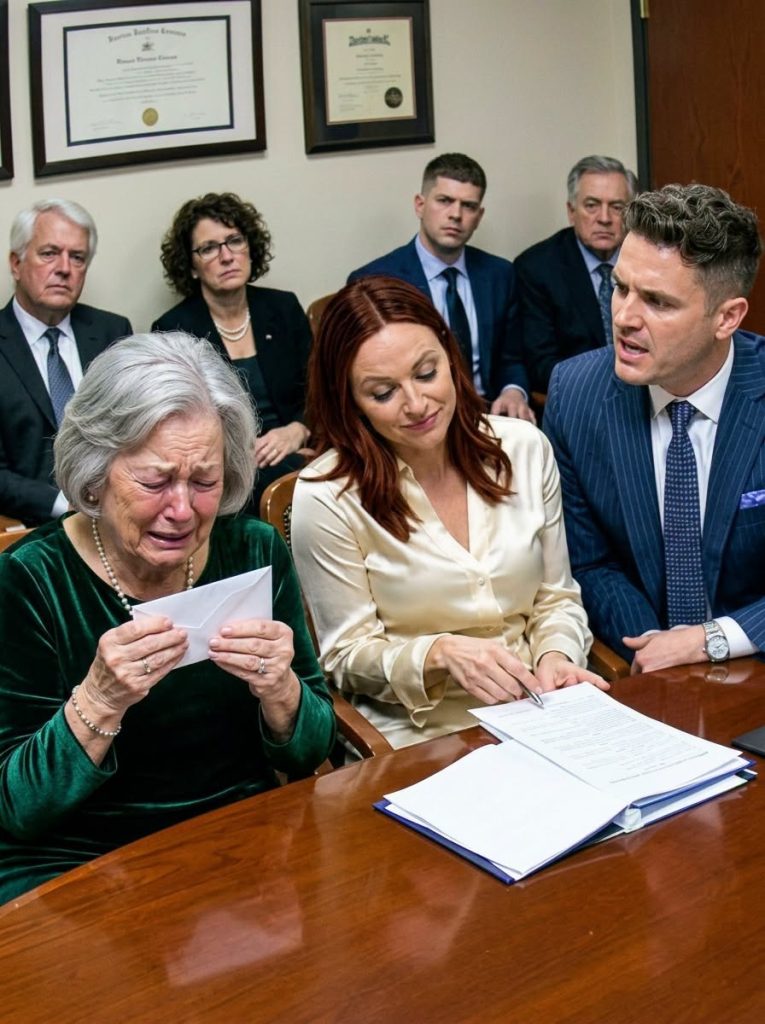
At the reading of my husband’s will, my children smiled.
I sat between them with a handkerchief twisted around my fingers, still expecting Roberto to appear in the doorway and complain that everyone was taking too long.
Instead, an attorney listed apartment buildings, land, investment accounts, and luxury cars.
Rebecca leaned forward.
Diego stopped checking his phone.
I stared at the attorney, wondering how the man whose medication I had struggled to afford could have owned any of it.
Then an envelope slid across the desk toward me.
Inside was a one-way ticket to Costa Rica.
“Peaceful place,” Diego said. “Perfect for someone your age.”
I was seventy-two, newly widowed, and apparently expected to disappear.
## Eight Years Beside His Bed
For eight years, Roberto’s illness had shaped our lives.
I helped him bathe, prepared his meals, and turned him in bed when he could no longer manage alone.
Between those tasks, I sewed.
Wedding alterations. School uniforms. Curtains. Anything customers brought through the door.
Some nights, I worked until my fingers cramped because another prescription needed collecting.
Our children visited occasionally.
Rebecca always had somewhere else to be. Diego stood beside the bed with his car keys in his hand.
When I asked for help, they offered explanations.
Mortgages. Business expenses. Difficult months.
I stopped asking.
Now, in that polished office, I listened as they inherited assets I had never known existed.
“Where did this money come from?” I asked.
The attorney, Mr. Salazar, folded his hands.
“Your husband held interests in several businesses over many years.”
“Then why was I sewing to pay for his medicine?”
Rebecca shifted impatiently.
“Mom, can we finish?”
I looked at her.
She looked back at the papers.
## The Envelope
Rebecca opened my envelope before handing it over.
A printed itinerary fell onto the desk.
San José.
Departure in three days.
No letter accompanied it.
Diego’s wife, Elvira, gave a small smile.
“Perhaps a change of scenery will help.”
Mr. Salazar cleared his throat.
“There are separate arrangements concerning your mother. I have been instructed to offer her a private appointment.”
“What arrangements?” Rebecca asked.
“Those are hers to discuss.”
But I had already stood.
After everything I had heard, I couldn’t bear another minute in that room.
That evening, Mr. Salazar called. He explained that someone would meet me on arrival, that my accommodation was arranged, and that I could postpone or decline the journey.
I agreed to go.
I needed answers, and Costa Rica seemed to be where Roberto had left them.
## The Photograph in the Drawer
While packing, I opened Roberto’s nightstand.
Beneath an old notebook lay a photograph.
A young Roberto stood beside a man who looked remarkably like him. Behind them were green mountains softened by clouds.
On the back, he had written:
**Roberto and Tadeo. Costa Rica, 1978.**
We had married in 1981.
In forty-five years, he had never mentioned Tadeo.
I packed the photograph beside our wedding picture.
Then I sat on the bed and looked around the room where I had cared for him.
I still loved him.
I was also beginning to wonder how much of our life he had allowed me to understand.
## Someone Waiting for Me
At the airport in San José, a man stood near the arrivals area holding a sign with my name.
“Mrs. Teresa Morales?”
“Yes.”
“I’m Moises Vargas. We spoke through Mr. Salazar’s office.”
He offered identification before taking my suitcase.
That small courtesy nearly made me cry.
During the drive, he explained that he had worked with Roberto for years.
“There is quite a lot to discuss,” he said. “You may prefer to rest first.”
“I’ve spent three days wondering whether my husband sent me away.”
Moises glanced toward me.
“He arranged a home for you here. Whether you stay is entirely your decision.”
“Then take me somewhere I can hear the truth.”
## Roberto’s Brother
At Moises’s office, I placed the photograph on his desk.
“Who is Tadeo?”
“Your husband’s twin brother.”
I leaned back.
“Roberto had a brother?”
“Yes.”
“Why didn’t he tell me?”
Moises opened a folder.
The brothers had invested together when they were young. Their first venture was a modest property business. Over the years, it expanded into rentals, commercial holdings, and an interest in a small hospitality company.
Then they fell out.
Roberto wanted to sell. Tadeo wanted to continue.
Their disagreement became personal, and they stopped speaking.
“Your husband retained some interests but distanced himself from the business,” Moises explained.
“And Tadeo?”
“He died two years ago.”
After Tadeo’s death, unresolved ownership matters and an estate distribution significantly increased Roberto’s available wealth.
The explanation accounted for some of the timing.
It didn’t account for all of it.
“He still knew more than he told me.”
“Yes,” Moises said.
I appreciated that he didn’t try to soften the answer.
## The House Above the Valley
The following morning, Moises drove me to a house overlooking a green valley.
It wasn’t a palace.
It had a shaded terrace, a bright kitchen, and a bedroom with doors opening onto the garden.
In a room near the front, a sewing table stood beside a wide window.
I stopped in the doorway.
There were shelves for fabric, a comfortable chair, and space to work without moving everything aside for dinner.
Moises handed me a letter.
“Roberto asked that you read this here.”
I recognized the uneven handwriting immediately.
**Teresa,**
**I owe you an explanation that I should have given while I could still look you in the eye.**
I sat down.
## The Letter He Should Have Written Earlier
Roberto wrote about Tadeo, their estrangement, and the money he had kept separate from our daily lives.
At first, he had told himself the investments were uncertain.
Later, secrecy had become habit.
When illness made him dependent on me, he felt ashamed of how long he had hidden them. Instead of confessing, he delayed.
After Tadeo’s estate was resolved, he began arranging for my future.
**I told myself I was protecting you from complicated matters,** he wrote. **But I left you carrying burdens that money could have eased.**
I pressed the letter flat against my knees.
There was no explanation that could return those exhausted nights.
He seemed to know it.
**This house and the income set aside for you are yours to use, sell, or refuse. Please do not mistake them for payment for your care. I cannot repay that.**
Near the end, he wrote:
**I hope you will choose what you want now, even if it is something I never imagined.**
I cried.
Then I folded the letter and asked Moises to show me every document.
## What Belonged to Me
Over the next several days, Moises explained the arrangements.
The house was held for my benefit, along with investments intended to provide regular income. There were funds available for travel, living expenses, and professional advice.
He encouraged me to have an independent attorney review everything.
I did.
I wanted no more mysteries.
Rebecca and Diego had received valuable assets, but those properties carried expenses, financing obligations, and management responsibilities.
Their inheritance was substantial.
It also required work.
Nothing had been arranged to suddenly strip it away.
They had simply heard the impressive numbers and stopped listening carefully.
My own provision had been made separately.
The plane ticket was an invitation to see it.
Unfortunately, Roberto had left others to explain what he should have told me himself.
## The First Phone Call
Rebecca called five days after I arrived.
“Are you settled?”
“I’m reviewing some documents.”
“What documents?”
“Documents concerning my home and finances.”
Her voice sharpened.
“What home?”
I described the house briefly.
Then came silence.
“Dad left you property?”
“Yes.”
“Why weren’t we told?”
“The attorney offered to explain my arrangements privately. You were busy discussing your buildings.”
She ignored that.
“Diego says some expenses are much higher than expected. We need to talk about pooling resources.”
I looked through the window at the sewing table.
“No.”
“Mom, we’re family.”
“Yes. We were family when I needed help caring for your father.”
She began explaining.
For once, I let her explanation end without rescuing her from it.
“You’ll need your own financial advice,” I said. “Mine is already arranged.”
## A Life With Room in It
I stayed in Costa Rica for six weeks.
I walked in the mornings. I learned the names of plants in the garden. I bought fabric because I liked it, without calculating how many alterations would cover the cost.
Eventually, I returned home to sort through my belongings.
Rebecca offered to collect me from the airport.
I accepted.
We drove quietly until she said, “I’m sorry about the ticket.”
I watched the road ahead.
“Thank you.”
It was a beginning. I wasn’t ready to decide what came after it.
Roberto’s photograph sits beside our wedding picture now.
I keep his letter in a drawer.
Some days, I feel grateful. Other days, I am angry about the choices he made for both of us.
I no longer force one feeling to erase the other.
When I sew, I work beside a window with daylight on my hands.
And when I stop, it is because I want to—not because someone else has finally decided I have done enough.