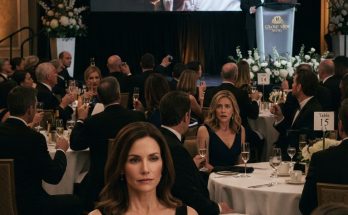
The toast ended, the orchestra struck up a lively country dance, and the guests returned to their revelry, instantly forgetting the quiet woman in the blue dress.
Lavinia turned away from the ballroom floor. She needed air. She needed to escape the cloying scent of the roses that she had personally haggled over with the village florist. She began to walk toward the darkened hallway leading to the kitchens, seeking a moment of silence to process the volcanic rage building in her chest.
She didn’t make it three steps before a sharp, imperious voice cut through the music.
“Lavinia! Stop dawdling!”
Lavinia froze. She turned slowly. Her mother, Lady Margaret, was sweeping toward her, her face pinched in an expression of intense annoyance. Lady Margaret was draped in heavy plum velvet, a diamond brooch—purchased on credit that Lavinia would have to figure out how to pay next month—gleaming at her throat.
“Mother,” Lavinia said, her voice frighteningly calm. “I was just going to step outside for a moment.”
“You have no time to step outside,” Lady Margaret hissed, grabbing Lavinia’s arm with surprising strength for a woman who claimed to suffer from chronic frailty. “One of the serving boys just dropped a tray of crystal glasses in the scullery. It is a complete disaster. The footmen are running about like headless chickens, and the next course is delayed.”
“Then let the butler handle it,” Lavinia replied softly.
Lady Margaret stared at her eldest daughter as if she had suddenly begun speaking in tongues. “The butler? He is busy attending to the Duke of Westmoreland! You are to go down to the kitchens immediately and manage the staff. Ensure the glass is swept up and the roast is brought out on time.”
Lavinia looked at the woman who had birthed her. “I have been on my feet since three o’clock this morning, Mother. I have not eaten. I am exhausted.”
Lady Margaret scoffed, a cruel, dismissive sound. “Oh, do not be dramatic, Lavinia. You are not the bride. You are the unmarried daughter. You don’t have a husband to dance with, and no one is looking at you anyway. You have the time and the energy. Now, go to the kitchens and do your duty.”
Do your duty.
Those three words, the shackles that had bound her for over a decade, echoed in Lavinia’s mind.
Something inside her finally changed. The invisible, fraying rope she had been holding onto for twelve long years simply snapped. The transition was absolute. She was no longer the dutiful daughter. She was no longer the beast of burden.
Lavinia gently, but with a terrifying, immovable strength, pried her mother’s fingers off her arm.
“No.”
The word was spoken quietly, but it carried a strange, heavy resonance.
Lady Margaret blinked. “I beg your pardon?”
“I said, no,” Lavinia repeated, her voice rising just enough to be heard over the nearest cluster of guests.
Arthur, who had been lingering near the punch bowl, noticed the confrontation. He swaggered over, a scowl on his handsome, flushed face. “What is the problem here, Mother? Is Lavinia being difficult again?”
Isadora, seeing her mother and brother gathering, abandoned her new husband and hurried over, eager to exert her newfound status as a married woman. “Lavinia, please do not cause a scene at my wedding. Mother asked you to do a simple task. Just go to the kitchens.”
The music seemed to dip. The guests standing nearby, sensing the sudden tension radiating from the Ashcroft family, turned their heads. The conversations slowed, a hush rippling outward from the small circle until a noticeable portion of the ballroom was watching them.
Lavinia looked around the ballroom. She looked at the crystal chandeliers she had climbed a ladder to clean because they couldn’t afford enough maids. She looked at the silk drapes she had mended. She looked at her family, standing in their finery, glaring at her with expectant, entitled outrage.
She took a deep breath, the air filling her lungs with an intoxicating, terrifying freedom.
“You were the ones who asked me not to marry.”
Her voice did not shake. It rang out like a silver bell in the suddenly silent ballroom. The orchestra, sensing the shift in the room’s attention, trailed off into a discordant silence.
Isadora flushed a deep, ugly red. “Lavinia! Keep your voice down! You are embarrassing us!”
“Embarrassing you?” Lavinia laughed. It was a cold, sharp sound that sent a shiver down her mother’s spine. “Isadora, you stood in front of this entire room ten minutes ago and thanked me for ‘giving up my happiness’ for you. You mocked my spinsterhood. Arthur mocked my age.”
Lavinia took a step forward, closing the distance between herself and her brother. Arthur actually took a half-step back, intimidated by the sheer, blazing intensity in his sister’s eyes.
“You mock my faded dress, Arthur,” Lavinia said, her voice projecting clearly to the hundreds of distinguished guests. “But you do not mention why I wear it. You do not tell your friends that the five thousand pounds you lost at the faro tables in London three years ago—the debt that would have seen you thrown into Fleet Prison—was paid because I secretly sold the Ashcroft emeralds and replaced them with glass.”
A collective gasp echoed through the ballroom. Arthur’s face drained of all color, turning an ashen, sickly white.
“Lavinia! Stop this instantly!” Lady Margaret shrieked, looking around at the horrified faces of the aristocracy.
“No, Mother,” Lavinia turned her fierce gaze upon the older woman. “I will not stop. For twelve years, I have lived in the shadows so that you could pretend the sun was still shining. When Father was crippled, you retreated to your bed. You left a seventeen-year-old girl to face the creditors who came to our door threatening to throw our furniture into the street.”
Lavinia turned to face the entire ballroom, refusing to shrink, refusing to hide.
“You praise Isadora’s beautiful wedding,” Lavinia declared, gesturing to the lavish spread. “You admire the flowers and the feast. But let me tell you the truth of Ashcroft Manor. We are bankrupt. We have been bankrupt for a decade.”
Murmurs of shock and scandalized whispers erupted from the crowd. Isadora’s new husband, Lord Harrington, dropped his glass of wine; it shattered on the floor, entirely ignored. He stared at his bride with a look of dawning horror.
“The only reason this house still stands,” Lavinia continued, her voice trembling not with sorrow, but with absolute power, “the only reason the tenants have not starved, the only reason there is food on this table tonight, is because I have spent twelve years balancing ledgers in the dark. I negotiated the debts. I managed the harvests. I surrendered my education, my youth, and my absolute sanity to maintain the illusion of your wealth.”
She looked back at her mother, tears of fury finally shining in her eyes.
“I had a man who loved me,” Lavinia whispered, the pain of a decade-old wound bleeding into her voice. “He offered me a life. But you begged me to stay, Mother. You wept and clung to my skirts, telling me you would starve without me. You asked me not to marry. And now, you stand in front of society and mock me for being the very thing you forced me to become.”
She let the silence hang in the air, heavy and suffocating. The Ashcroft family stood paralyzed, their reputations, their lies, and their absolute cruelty laid bare before the entire county. There was no recovering from this. The illusion was completely, irrevocably shattered.
Lavinia looked at the faces of the people who had drained her lifeblood, and she felt nothing but a profound, beautiful emptiness.
She stood tall, smoothing the skirts of her faded blue dress.
And finally, she said four words no one in that room ever expected to hear from the dutiful, silent sister.
“I am leaving tomorrow.”
“You can’t!” Arthur shouted, panic finally breaking through his shock. The reality of what her absence meant—the ledgers, the creditors, the management—crashed down upon him. “You can’t leave! Who will run the estate? Who will pay the bank?”
“That, Arthur,” Lavinia said softly, “is no longer my concern. I suggest you learn how to use a quill.”
She turned her back on them. She intended to walk out of the ballroom, pack a single valise with her meager belongings, and walk into the night if she had to.
But as she took her first step toward the exit, a figure detached itself from the crowd.
He was a tall man, impeccably dressed in a stark black evening coat that emphasized his broad shoulders. His dark hair was threaded with silver at the temples, and his piercing, intelligent gray eyes were locked entirely on Lavinia. The crowd parted for him instinctively, recognizing the aura of absolute, untouchable power he carried.
It was Alexander Thorne, the Duke of Westmoreland. He was one of the wealthiest and most formidable men in the kingdom, a man whose business acumen was legendary, and whose private life was fiercely guarded.
What Lavinia didn’t know—what no one in the room knew—was that the Duke of Westmoreland was the primary holder of the massive debts the Ashcroft estate had accrued over the last decade. He had purchased the debt from lesser banks years ago. And he was the man Lavinia had been secretly exchanging letters with for five years, negotiating interest rates, proposing agricultural yields, and securing extensions.
He had never met her in person. He had assumed the brilliant, fiercely intelligent letters signed only “L. Ashcroft” had been written by Lord Ashcroft himself, or perhaps a highly educated steward. He had attended the wedding tonight purely out of curiosity to meet the man who had so masterfully kept a sinking estate afloat.
Instead, he had stood in the shadows, listening to the agonizing, magnificent truth.
The Duke stepped directly into Lavinia’s path. The entire ballroom held its breath, expecting the powerful nobleman to rebuke the hysterical woman who had ruined a high-society wedding.
Instead, Alexander Thorne stopped three feet from Lavinia, removed his pristine white gloves, and bowed to her. It was not a polite, perfunctory nod. It was a deep, courtly bow of absolute, profound respect.
“Lady Lavinia,” the Duke said, his deep, resonant voice carrying effortlessly through the silent room. “I have corresponded with you for five years regarding the debts of this estate. I have marveled at your financial acumen, your honor, and your relentless dedication to a family I now see is entirely unworthy of you.”
Lady Margaret gasped, clutching her chest. Arthur looked as though he might faint. The man holding the deed to their survival was declaring his allegiance to the sister they had just mocked.
Lavinia stared at the Duke, her breath catching in her throat as she realized who he was. “Your Grace… you are the creditor.”
“I am,” Alexander replied, his eyes softening as he looked at her faded dress and the ink stains still faintly visible on her fingertips. “And I came tonight to finally meet the brilliant mind that saved Ashcroft Manor. I had no idea the mind belonged to a woman who has been treated as a slave in her own home.”
The Duke turned his formidable gaze upon Arthur and Lady Margaret. The sheer contempt in his eyes made them physically recoil.
“Lord Arthur,” the Duke said, his voice cold enough to freeze water. “I have extended immense leniency to this estate purely out of respect for the business proposals outlined by your sister. Since she is leaving your employ tomorrow, you will consider that leniency revoked. My agents will be here on Monday morning to audit the ledgers and begin foreclosure proceedings.”
“Your Grace, please!” Arthur begged, dropping to his knees. “We will be ruined!”
“You were ruined twelve years ago, boy,” the Duke sneered. “You simply lacked the intelligence to realize it. Your sister has been carrying your corpse on her back.”
Alexander turned back to Lavinia. The coldness vanished, replaced by a warmth and a gentle admiration that made Lavinia’s heart stutter. He held out his arm to her.
“Lady Lavinia,” the Duke said softly. “I have need of a brilliant estate manager for my northern properties. It comes with a substantial salary, a private residence, and the absolute respect of everyone in my employ. And, if I may be so bold, I should very much like the opportunity to court the most extraordinary woman I have ever had the privilege to meet.”
The ballroom erupted into a frenzy of whispered chaos, but Lavinia heard none of it. She looked at the Duke’s extended arm. She looked at the man who saw her not as a beast of burden, not as a spinster to be pitied, but as a brilliant, resilient woman worthy of respect.
She looked back at her family one last time. Isadora was weeping hysterically, her new husband pulling his arm away from her, furious at the deception of her wealth. Her mother was swooning into a chair. Arthur was sobbing on the floor.
Lavinia felt no pity. She had paid her debts.
She turned back to the Duke, a radiant, genuine smile breaking across her face for the first time in twelve years. She reached out and placed her hand on his strong arm.
“I accept your offer, Your Grace,” Lavinia said, her voice steady and bright. “Take me away from here.”
And as the Duke of Westmoreland escorted the woman in the faded blue dress out of the grand ballroom, walking past the shattered illusions of the Ashcroft family, Lavinia realized that the youth and happiness she thought she had surrendered had not been destroyed. It had simply been waiting for her to have the courage to walk out the door.