Our colleague excused herself.
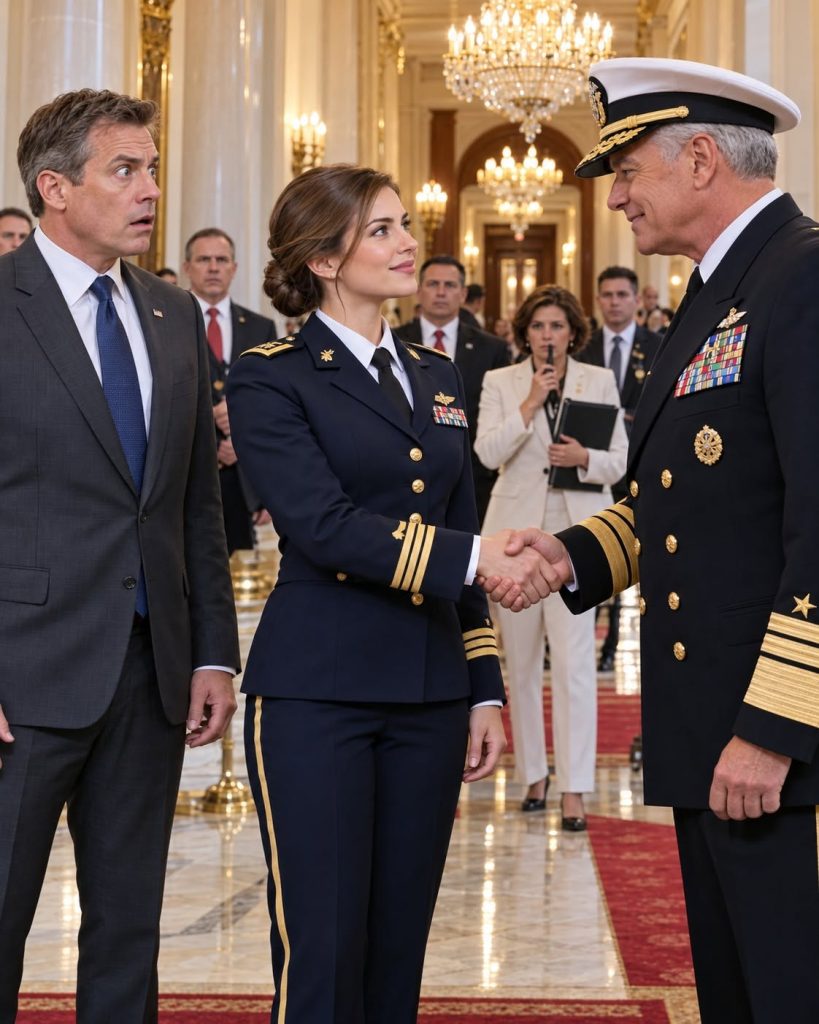
Mitchell watched her leave.
“You could have said that privately.”
“I have. Several times.”
He looked back at me.
For three years, I had tried to explain why the jokes bothered me.
He called them affectionate.
When I stopped laughing, he said I had become sensitive.
Now we stood beneath a chandelier, surrounded by people who knew my work, and he finally seemed willing to hear the sentence.
I wished it hadn’t required this room.
The Reception
Someone approached to ask about a former colleague.
Then another person congratulated me and mentioned two members of my team.
I answered their questions within the limits of what I could discuss.
Mitchell stood beside me.
At first, he tried to enter every conversation.
Eventually, he began listening.
A civilian official spoke about coordinating medical supplies when normal routes became unavailable.
An officer described a difficult transport decision.
Nobody suggested that planning was separate from service.
They understood what happened when the right equipment, medicine, fuel, or vehicle didn’t arrive.
For years, Mitchell had treated that work as background.
That evening, he heard people discussing its consequences.
What the Citation Left Out
The ceremony’s account was necessarily limited.
It couldn’t describe every location, decision, or complication.
It also couldn’t capture the ordinary persistence behind the outcome.
People checking figures when they were exhausted.
A junior specialist catching a discrepancy before it became a serious problem.
Someone staying on a call until two organizations finally understood what the other needed.
My contribution mattered.
So did theirs.
The recognition didn’t turn me into a different officer.
It gave a public shape to work I had already valued.
I wanted Mitchell to understand that distinction.
The Drive Back
We left later than expected.
For several minutes, he drove without speaking.
Then he said, “You should have told me about the invitation.”
“I should have.”
He glanced toward me, surprised.
“I was hurt,” I continued. “I kept it to myself because I didn’t want another conversation that ended with you dismissing something important to me.”
“So you wanted me embarrassed?”
“I wanted to attend without asking you to take it seriously first.”
He tightened his grip on the wheel.
“I would have.”
“You hadn’t before.”
The road ahead was quiet.
Neither of us could settle three years of habits before reaching home.
The Question at Breakfast
The next morning, Mitchell found me reading messages from my team.
He set down his coffee.
“Tell me what I’ve been getting wrong.”
I put the phone aside.
“About my work?”
“About how I treat it.”
That was a better question.
I told him how often he introduced me by describing what I supposedly didn’t do.
How he interrupted when I tried to explain something.
How his mother’s comments became harmless only because he expected me to absorb them.
“And when I object,” I said, “you explain why I shouldn’t mind.”
He listened.
I had no way to know yet whether listening would become change.
But I finished speaking without being interrupted.
Respect Without a Citation
I asked him a question.
“If my work had never been recognized last night, would the jokes have become acceptable?”
“No.”
“Then the ceremony isn’t the reason to stop.”
He nodded.
“I understand.”
I hoped he did.
There were plenty of people whose necessary work would never produce an invitation, a photograph, or applause.
Their partners still owed them curiosity and respect.
I didn’t want to win an argument by proving I had been secretly impressive enough.
I wanted a marriage where neither of us needed that proof.
His Mother Calls
His mother called that afternoon.
Mitchell answered in the kitchen while I sorted laundry nearby.
“I hear our little spreadsheet girl had quite an evening,” she said brightly.
I stopped folding.
Mitchell looked toward me.
Then he answered.
“Her name is Sloane, Mom.”
“Oh, don’t start. It’s a joke.”
“She’s asked us to stop.”
There was a pause.
He didn’t offer my citation as justification.
He didn’t explain that senior officials now admired me.
He simply held the boundary I had already stated.
After the call, I thanked him.
Then I returned to the laundry.
We weren’t going to turn every decent response into another ceremony.
The Work at Home
We arranged counseling.
I didn’t want us to keep repeating the same conversation until we both became skilled at reciting it.
Some sessions were uncomfortable.
Mitchell admitted how easily he measured his own success against other people’s attention.
My independence had felt like competition when it should have been something he welcomed.
I acknowledged how often I withdrew rather than stating what I needed clearly.
That didn’t make his belittling my fault.
It did give me something I could change without waiting for him.
We learned to discuss one problem at a time.
We also learned to pause when a conversation became another attempt to win.
Back With My Team
At work, the event quickly gave way to ordinary demands.
There were meetings, schedules, and new questions.
Someone taped a paper crown beside my monitor.
On it, they had written:
Queen of Spreadsheets.
I looked at the colleague responsible.
She grinned.
“We mean that with considerable professional admiration.”
I laughed.
Context mattered.
So did knowing I could ask her to remove it and be heard.
I sent the team the official photograph once it was available.
Then we returned to the work it represented.
A Different Introduction
Months later, Mitchell and I attended a neighborhood dinner.
Someone asked what I did.
Before I could answer, he began.
“Sloane’s in Army logistics.”
I waited.
He turned toward me.
“She can explain it better than I can.”
It was a small moment.
No protocol officer.
No admiral.
Nobody holding a citation.
I described my work in terms I could share.
The person listening asked a thoughtful question.
Mitchell stayed quiet long enough to hear my answer.
Later, walking home, he asked about a detail I had mentioned.
I told him.
For once, I wasn’t preparing a defense of my career.
We were simply talking about my day.
My Husband Called Me the “Queen of Spreadsheets”—Then Heard My Work Recognized at the White House
Advertisement