My husband of 22 years suddenly told me “we’re not meant to grow old together,” signed over the house and all our savings, and walked out. While I was on a solo cruise to heal from the divorce,
a stranger sat down at my dinner table and placed a broken silver necklace next to my bread basket.
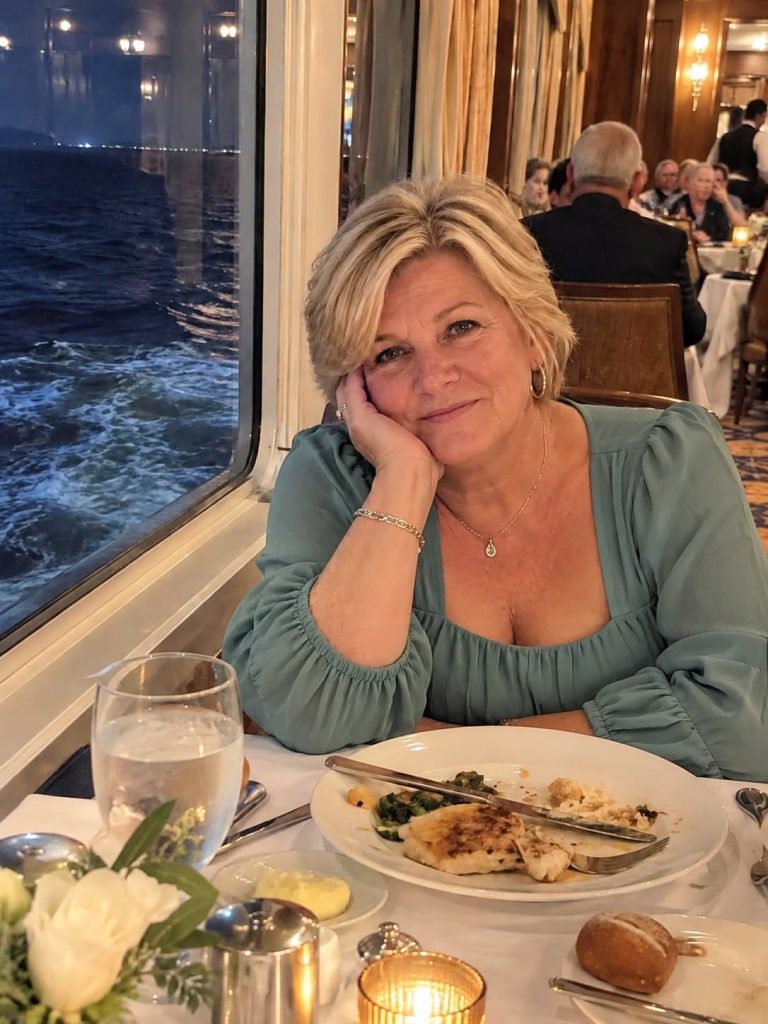
And beneath it was a laminated bereavement card from a funeral home in Seattle, dated nineteen years ago.
Staring back at me from the oval photograph on the card was a younger version of the man sitting across from me—except in the photo, he had dark hair, a wider smile, and the name *Daniel Vance* printed beneath his face.
I knew that card. I had found it six years ago inside a locked fireproof box in the back of my husband Mark’s closet, tucked alongside the broken silver medal and a yellowed newspaper clipping about a fatal hit-and-run on Highway 99. When I had asked Mark about it back then, he had told me Daniel was a college roommate who had been killed by a drunk driver on a rainy November night, and that he kept the medal in his memory.
Except Daniel Vance didn’t look like a college roommate. He had the exact same high cheekbones, the same narrow jaw, and the same deep-set hazel eyes as the man sitting in front of me.
“You’re his brother,” I whispered, the dining room noise blurring into a dull roar. “You’re Daniel’s brother.”
“Twin brother,” the man corrected quietly. “My name is Paul Vance. That St. Christopher medal belonged to our grandfather. I put it around Daniel’s neck the morning he drove to Seattle for a job interview. The police told us the chain must have snapped on impact and gotten lost in the weeds by the ditch. For nineteen years, my mother died believing that medal was rusting in the mud on the side of Highway 99.”
My fingers curled into the edge of the tablecloth. “How did you get it?”
“A courier delivered it to my law office in Portland five weeks ago,” Paul said, his voice steady, clinical, and cold. “Along with that funeral card, a cashier’s check for four hundred thousand dollars—which was the exact value of my husband’s pension and half the equity in our house—and a four-page handwritten confession signed by Mark Miller.”
The air left my lungs in a sharp gasp. Waiters were moving gracefully between the tables around us, pouring Pinot Noir and setting down plates of braised short ribs, while my entire life was being dismantled piece by piece over the breadbasket.
“A confession?” I breathed. “To what?”
Paul leaned forward, resting his forearms on the table. There was a terrible, hollow grief in his eyes, mixed with something that looked almost like pity.
“Nineteen years ago, Claire, you were three months pregnant with your daughter,” Paul said softly. “You were placed on strict bed rest after a hemorrhage, and you had just lost your job. Mark was working double shifts as a junior accountant, driving a rusted sedan with bald tires and expired insurance because every dime you had was going toward hospital bills.”
I nodded dumbly. I remembered that winter. I remembered how terrified we had been, and how Mark had come home one night white as a sheet, claiming he had slid into a guardrail on an icy overpass and totaled the car, before scraping together enough cash from a high-interest loan to buy a cheap beater the next week.
“It wasn’t a guardrail,” Paul said, reading my face. “It was Daniel. Daniel’s car had stalled on the shoulder in the pouring rain. He was standing by his trunk setting up a reflective flare when Mark hydroplaned. Mark got out of the car. He checked Daniel’s pulse. Daniel was already gone—and when Mark grabbed his collar to pull him out of the puddle, that silver chain snapped off in Mark’s hand.”
I pressed my hand over my mouth to trap the sob rising in my throat. “No. Mark wouldn’t leave someone on the side of the road. Not Mark.”
“He dialed 911 on his flip phone,” Paul continued, his voice tight. “He wrote about it in the letter. He stood in the rain looking at my brother’s body, and all he could see was you lying in a hospital bed, losing the baby if he went to prison for vehicular manslaughter on expired insurance. So he panicked. He hung up before the dispatcher answered, got back into his car, and drove away. Two weeks later, ridden with guilt, he drove to Seattle and stood in the back row of Daniel’s funeral. He took that laminated card from the usher’s basket and swore to himself he would spend the rest of his life being the perfect husband and father to justify the life he stole.”
Tears spilled hot and fast down my cheeks. “Why now? After nineteen years… why would he send you that box five weeks ago?”
Paul looked out the porthole window at the black water before looking back at me.
“Because four months ago, the King County Cold Case Unit used a new forensic paint-transfer database to re-examine evidence from the 2007 hit-and-run,” Paul said. “They narrowed the paint chips found on Daniel’s parka down to a specific batch of factory primer used on only three hundred sedans sold in the Pacific Northwest. It was on the local news in Seattle. Mark saw the broadcast. He knew it was only a matter of months before the state police worked their way down the registration list to his old VIN number.”
The whole room seemed to tilt with the roll of the ship.
*We’re not meant to grow old together.*
Mark’s exhausted face at our kitchen table flashed in my mind. The way he wouldn’t look me in the eye. The speed with which he had signed over the house, the cars, and the entirety of our joint savings accounts in the divorce settlement, leaving himself with nothing but a studio apartment and an old pickup truck.
“He didn’t fall out of love with you, Claire,” Paul said quietly. “He divorced you to sever your assets from his name before the state could seize them in a wrongful death suit. And he cut you loose so that when the marshals arrested him, you would be the blindsided ex-wife he abandoned—not the woman standing beside a killer in a courtroom while your daughter watched.”
“Arrested him?” My voice cracked so loudly a couple at the next table glanced over. I grabbed Paul’s wrist across the table. “When?”
“Mark walked into the King County Sheriff’s precinct on Monday morning—the day after your ship left port,” Paul said. “He waited until you were out in international waters with no cell service so you couldn’t fly back and try to hire him a defense team with your retirement money. He waived his right to bail and pleaded guilty this morning.”
I stared at the silver medal gleaming softly under the chandelier.
Twenty-two years of gentle mornings, of him rubbing my feet when I was pregnant, of him coaching our daughter’s softball teams and waking up at three in the morning whenever he thought I was having a bad dream—except it had never been my nightmares keeping him awake. It had been his own.
“Then why are you here?” I asked, my voice trembling with a mixture of grief and terror. “How did you even find me on this ship? Did you come here to watch me fall apart?”
Paul slowly pulled his wrist back, reaching into his pocket one last time to pull out a sealed cream-colored envelope with my name written across the front in Mark’s neat, familiar handwriting.
“Your sister told me which cruise you were on when she went by Mark’s apartment to drop off his mail and found the detectives there,” Paul said, sliding the envelope across the linen until it touched my fingers. “Mark begged me in his confession to never let you know the truth. He wanted you to hate him forever so you could move on clean.”
Paul stood up, buttoning his suit jacket as the older couple from Oregon finally appeared at the entrance of the dining room, waving cheerfully in my direction.
“For nineteen years, my family lived in the dark, wondering who left Daniel in the rain and why,” Paul said, looking down at me with solemn, quiet eyes. “I found out two things over those nineteen years, Claire. First, a man should have to pay for what he did. And second, nobody deserves to spend the rest of their life being lied to about why the person they loved disappeared. Not my mother. And not you.”
He gave me a slight, stiff nod, turned on his heel, and walked out of the dining room, leaving me alone at the window with a dead boy’s medal and the last love letter my husband would ever write from a prison cell.